



Your capital is at risk if you invest. You could lose all your investment. Please see the full risk warning here.
On the 11th of October, Saudi Arabia's airport in capital Riyadh was attacked1 for the second time in as many days by a swarm of missiles and drones fired by the Houthi group in Yemen - which has long battled a Saudi/UAE-led coalition in its country. On the same day2, Iran struck six tankers attempt to navigate through the Strait of Hormuz via what the country's government stated were "unauthorized routes" with their transponders switched off to avoid detection. With the Houthis dictating terms on traffic through the Red Sea and Iran effectively controlling energy flows through the rest of the Middle East, a massive chunk of energy needed to power East Asian powers and Europe now effectively are out of reach - at least in actuarial terms needed to guarantee shipping.
Meanwhile, over in San Francisco, reports have emerged3 that Anthropic is now – after over a month of delays and many more in messaging – moving to list after the midterm elections. This timing might be tenuous; especially considering firm correlations between energy crises and IPO deal volume statistics compiled over the past five decades.
How IPOs and Energy Flow Together
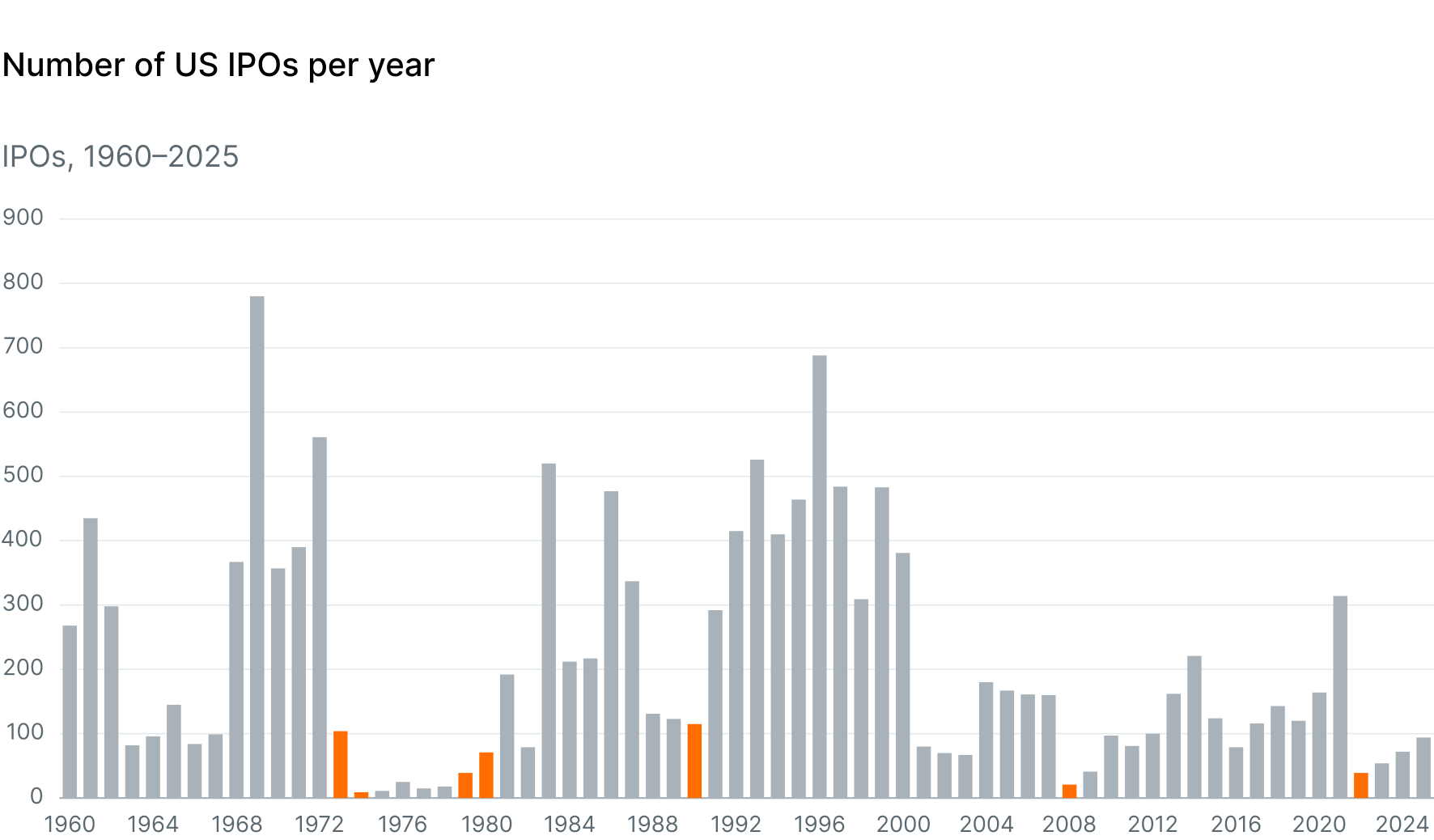
While there is no strict direct causation between post-IPO performance and conflict, energy crisis is a slightly different beast.
Source: IPOVitalSigns, University of Florida, Leverage Shares analysis
The 1970s started with a brief recovery from the late-1960s contraction in IPO volume. However, the 1973–74 Arab oil embargo nearly caused the U.S. IPO market nearly shut down. Issuance fell from hundreds a year to roughly single digits in 1974 as stocks lost close to half their value. Furthermore, large blue-chip growth stocks – then known as the “Nifty Fifty” – peaked in 1972–1973 before crashing hard.
The 1979–80 Iranian revolution saw oil reaching record highs while the Fed’s policy rate was near 20%. The 1990 Gulf War saw oil roughly doubling and IPO volume drying up in late 1990. The 2008 oil spike and financial crisis saw many issuers pull their deals. The 2022 Russo-Ukrainian energy shock saw post-IPO performance slump and issuers pull back into the next year and beyond.
The underlying factors can be assumed to travel through interest rates and volatility, rather than via energy directly. Higher oil prices raise inflation, which raises rates and discount rates. In turn, higher discount rates hurt companies whose value depends on distant future earnings the most. A company goes public to raise capital and access debt markets better; borrowing thus becomes more expensive.
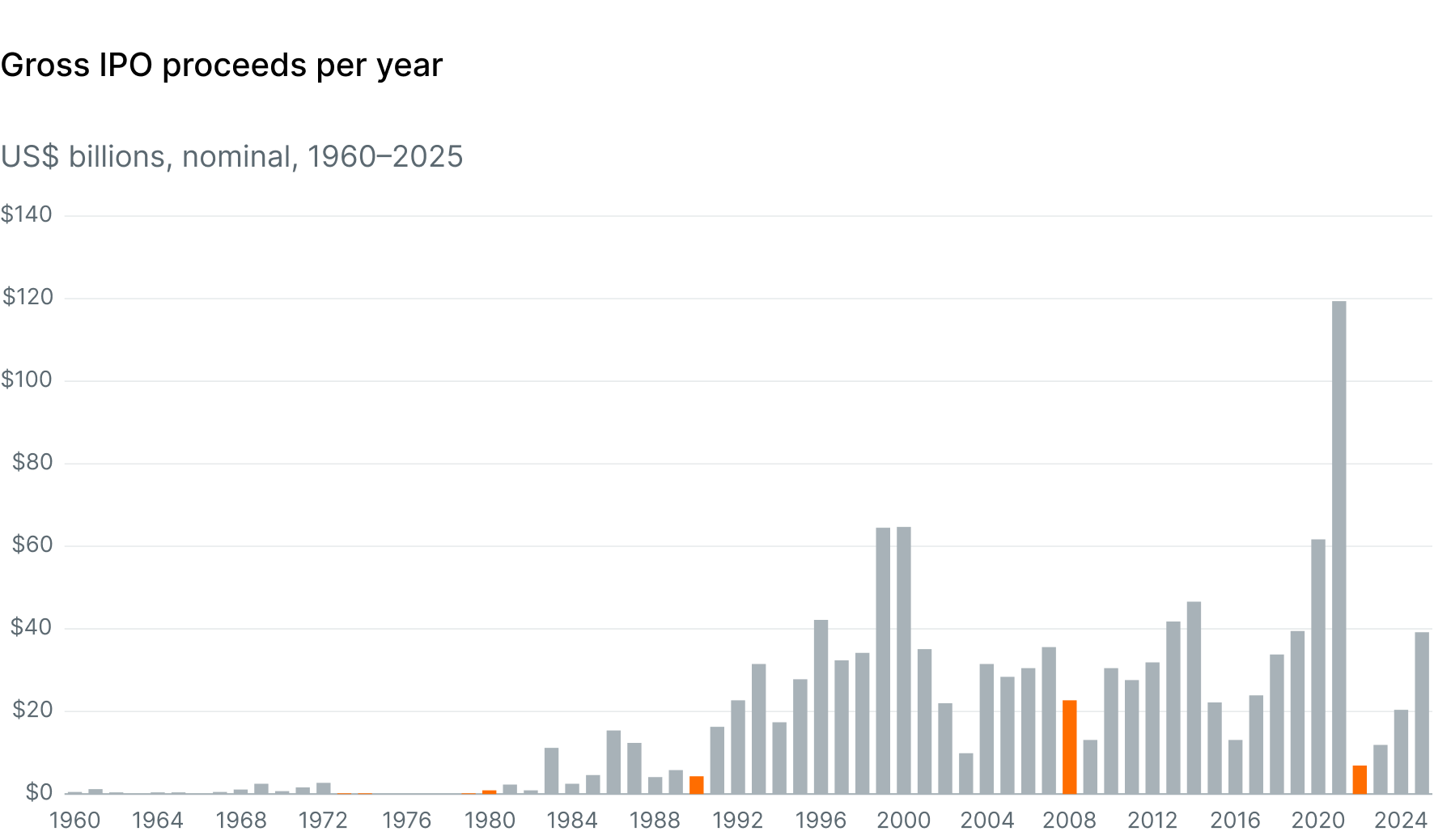
The five decades of data also indicate a seeming shift particularly as the nineties rolled in: tech arrived in force and raised post-IPO proceeds to unprecedented levels as investors switched to niches companies commanding vast physically visible industrial and commercial facilities never could. However, gross IPO proceeds - a point of concern for the IPO underwriters - show a distinct relationship to trenchant energy crisis in the post-Cold War period.
Source: IPOVitalSigns, University of Florida, Leverage Shares analysis
Despite the tech-heavy IPO market being a richer vein than classical sectors had been, gross IPO proceeds show a distinct break upon every crisis year relative to recent performance.
Despite crisis, some companies did go on to list with great success. What defined their success has generally been heavily contextual.
What Make for Strong IPOs During Crisis
2008 had only 21 IPOs but still raised $22.8 billion, with Visa’s $17.9 billion IPO accounting for roughly 80% of that. While 2022 had an average 47.7% average first-day return on 39 deals, a handful of small IPOs that year essentially skew it.
Essentially, large high-quality issuers can still raise money during a crisis and this comes with some precedent: Genentech (which listed in October 1980) nearly doubled on day one of the IPO listing while Apple (which listed in December 1980) rose about 30% within a single day. Within these examples, the underlying success factors are somewhat varied:
The likes of Visa (and even Cisco, which listed in February 1990, i.e. before the Gulf War shock) were profitable with strong cash flows, thus making their balance sheet their strength.
The likes of Genentech and Apple were relatively modest in terms of revenue but were resilient in their narrative of new and demonstrable technology.
After recovery from crisis, broader investor appetites promoted risk-taking and rose all boats. For instance: once Operation Desert Storm ended the uncertainty in early 1991, a multi-year IPO boom followed.
Anthropic has a number of factors in its reported fiscals and structure so far that potentially gives a wide swathe of investors as well its underwriters cause for jitters for going forward in a period of energy crisis.
What Might Push Back Anthropic's IPO
While Anthropic has signalled that it's going slow on its listing to address AI safety concerns, the simple fact is that its fiscals do not (at least currently) show the balance sheet as its strength.
Excluding an accounting charge, its operating loss in 2025 was $8.1 billion, which translates to about $1.76 spent per dollar of revenue. Two customers made up almost a quarter of 2025's revenue, and many large customers lack long-term contracts. While conventional debt seems modest - especially relative to the sought $2 trillion valuation - and consists of a $15 billion revolving credit line and convertible notes sold to both Amazon and Alphabet, Anthropic owes at least $518 billion to compute and infrastructure suppliers over the next decade, with about 80% of this commitment being either non-cancellable or payable regardless of actual capacity used.
Large fixed commitments make a company more sensitive to higher interest rates and to any slowdown in demand. That is the same risk factor that energy shocks magnify on the valuations of growth stocks without sustained cash-generating segments.
In 2025, the median US IPO is estimated to have reached about 8 times trailing sales at first close. At a $2 trillion valuation, Anthropic seeks to trade at roughly 20 to 30 times its annualized run-rate revenue. While trailing sales and run rates aren't strictly comparable, the gap is telling.
In a scenario wherein major energy-producing regions are committed to a stalemate and thus lead to a predictable range of oil prices, a narrative-driven IPO could be workable. What would hurt the likes of AI frontier labs is listing in a week punctuated with sudden escalation along with a reliable history of thereof. Since the end of February and the nearly 40 times the Trump administration signalled a ceasefire or deal with Iran that didn't hold, it is essentially now predictable that the next ceasefire/deal announcement might not hold either.
Midterm Election Outlook
Polls now seem to indicate that the Democrats are set to win the House and, increasingly, perhaps the Senate as well. However, the American electorate shows a stark divide from their elected representatives. In the question over the Middle East, for example, even Democrat leader Chuck Schumer has said he will keep fighting to get Israel all the aid it needs – thus ensuring bipartisan support for Israel’s strategies in the midst of the conflict in the Middle East at the legislative level. However, the voters tell a different tale: recent surveys indicate as much of 75% of Democrat voters oppose more military support for Israel while numerous polls indicate that the same sentiment has crossed the halfway mark among Republican voters as well.
Another major energy-producing region is the Russia-Ukraine front – wherein a spate of attacks by both sides have left refining and export facilities in various states of damage. A Democrat-dominated House is expected to make US support for Ukraine more likely, especially via loans and sanctions. While the promise of military aid is running at low levels of support on a bipartisan basis, this could flip - as it has on a couple of occasions even during the current Trump administration. On the subject of Ukraine as well, the leadership is at odds with the voters across the spectrum – a sizeable chunk of the latter (again above the halfway mark) is variously polled as being in favour of completely disengaging from the conflict.
While the split between representative and electorate could carry reverberations in the long run within the ranks of the American two-party system if this sentiment isn’t shown at the political level, it is entirely unclear if public sentiment would move the post-midterm legislative bodies towards ending US involvement in these conflicts definitively. Given how polarizing Trump is, he could serve as the lightning rod for most of the criticism from voters across the spectrum over their representatives’ inability (or unwillingness) to execute on their sentiment. If conflict were to find support (even via inaction) after the midterm elections, then the risk climate for the listing of a growth story such as Anthropic becomes more pronounced for the underwriters and lead to even more delays.
While Anthropic and OpenAI have both been highlighting “AI safety” as an important matter of consideration among frontier labs and a factor for the delay in listing, there is another consequence embedded within this narrative: in the face of increased oversights, new labs (a.k.a. the competition) would face challenges in accessing the broader market. With fewer competitors, the market would lean towards consolidation. Revenue lines firm up and growth prospects find more support.
However, the AI market today isn't operating in quite the same environment that broader tech industry had till date: various countries around the world recognize the need to maintain sovereign capabilities. An “AI safety” regulation regime brought into effect by the US wouldn't necessarily be acceptable in, say, China, India, other parts of Asia and so forth. AI – or at least the underlying frameworks – are deemed strategic enough now to warrant favourable growth climates elsewhere. There are very few industries wherein regulations were uniformly applied. If the US were to enact them, so would other countries – which would work against the addressable market the likes of Anthropic would like to highlight to investors.
All in all, it would be premature to assume that the US' role in the current conflicts in Europe and the Middle East would substantially reduce immediately after the midterm elections, regardless of result. If the conflict were to continue, it's entirely likely that Anthropic's IPO underwriters would seek to push back the listing date even further.
Professional investors in Europe might consider instruments based on energy instruments such as the +3x Long Oil & Gas ETP (XLE3), the -3x Short Oil & Gas ETP (XLGS), the +3x Long WTI ETC (WTI3), the -3x Short WTI ETC (WTOS), the +3X Long Natural Gas ETP (NGL3), the -3X Short Natural Gas ETP (UNGS), and the Brent Oil ETC (1BRN).
In the AI space, investors might consider the +3X Long Artificial Intelligence ETP (GPT3) and the -3X Short Artificial Intelligence ETP (GPTS).
For investors interested in the potential for earning monthly income from the trajectory of AI-relevant instruments, the Artificial Intelligence Leaders ETP (ARIY) may be considered.
Footnotes
“One killed, 11 injured in second Houthi strike on Riyadh airport in two days”, BBC News, 11 October 2026
“Ships in Hormuz strait hit by worst spate of attacks since start of war”, Financial Times, 13 October 2026
“Anthropic IPO launch shifts toward mid-October, sources say”, Reuters, 5 September 2026
Your capital is at risk if you invest. You could lose all your investment. Please see the full risk warning here.
 Market Insights

