



Your capital is at risk if you invest. You could lose all your investment. Please see the full risk warning here.

Over the past month or so, bond markets in the U.S., Eurozone and even some Asian economies such as Japan have been in turmoil after a broad selloff drove down prices and raised yields. A number of macro factors seem to have driven this phenomenon:
A strong jobs report indicating that U.S.’ employment numbers remained strong as the year ended while the unemployment rate remained low implied that the Federal Reserve has no incentive to initiate a rate-cutting cycle sooner.
Stubborn inflationary pressures remain in place throughout the countries whose bond markets were affected, despite preventive measures deployed.
There is, however, additional nuance that needs to be added. As far as indicators go, there isn’t substantial incentive for the Federal Reserve to substantially raise rates: in recent history, rising Consumer Price Index (CPI) levels didn’t trigger rates hikes as long as employment numbers remained steady: a strong labour market inevitably strengthens the case for rates to remain higher for longer. While employment numbers have certainly remained strong, wage growth is steadily being outstripped by diminishing affordability of real estate, automobiles, holiday spending, vacations and even consumables. Meanwhile, energy prices also remain bullish on account of geopolitical conflicts and rising demand around the world.
A classical argument in market dynamics is that if bond yields rise, future cash flows accruable by companies will be discounted at a higher rate, which is a net negative for equity valuations. Higher bond yields would also imply a higher cost of funding for companies and increased solvency risk. Therefore, equity markets would decline.
When juxtaposing U.S. market volumes and the S&P 500’s change in valuation versus U.S. Treasury yields in the recent past, however, this classical maxim doesn’t seem to hold.
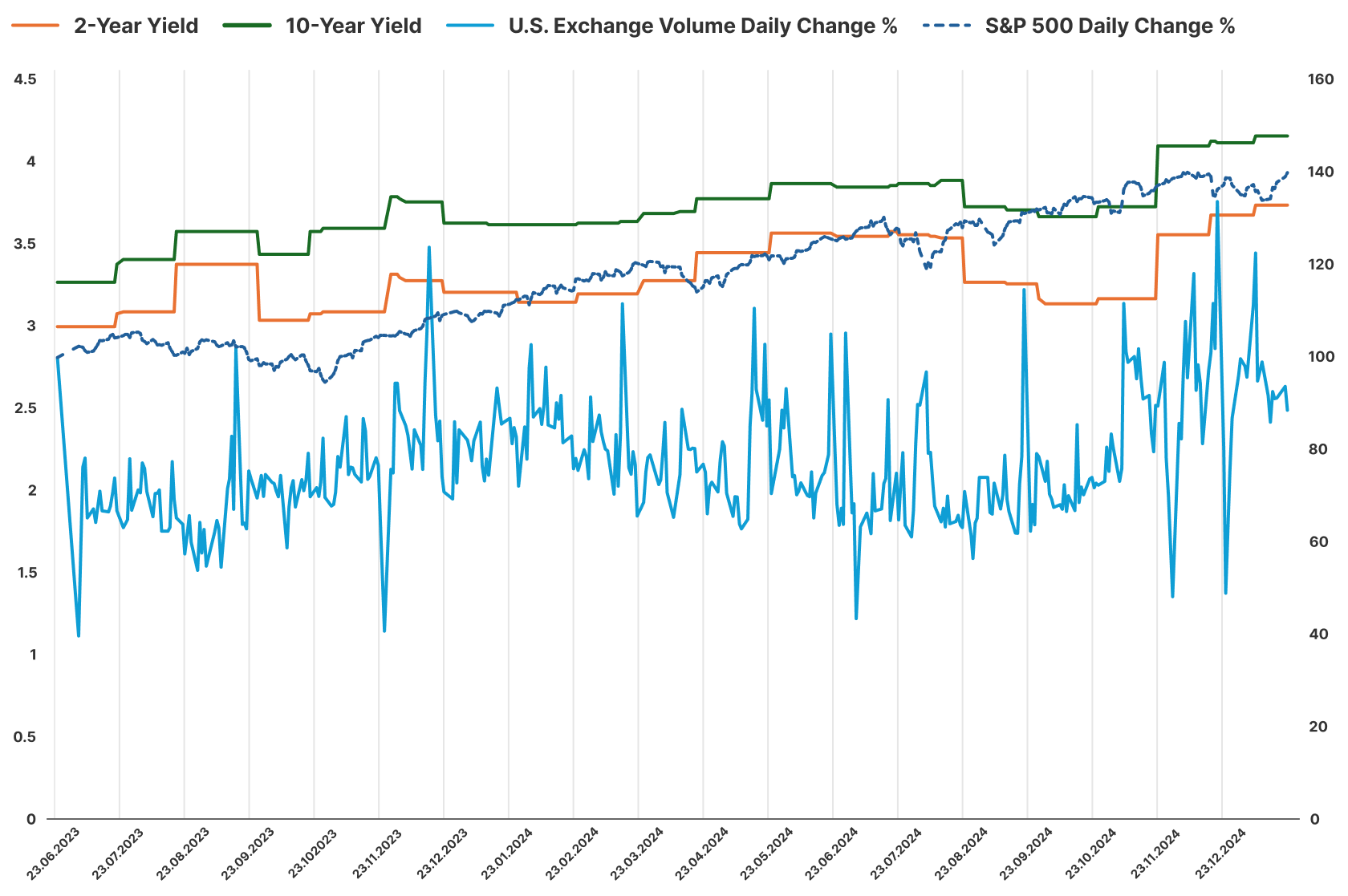
Source: Leverage Shares analysis
Not only do equity valuations seem to hold up even when volumes show drastic drops, rising yields does little by way of affecting valuations – although market volumes do tend to fluctuate when this happens.
This implies that the market doesn’t seem to find too much allure in the viability of rising yields being an effective alternative to remaining invested in equity markets. In indirect terms, this is also an indictment of the bond selloff-afflicted countries governments’ ability to handle pressures on their citizenry with current/classical inflation control mechanisms and policies.
The bond selloff should also be a warning of sorts to the central banks of affected countries: their debt isn’t likely to continuously evoke investor interest beyond that required as being held by portfolio management principles. For portfolio growth and targets, markets continue to look upon the private sector.
However, not all equities are created equal nor are they all rising together. For the better part of 2024 and beyond, the market has been increasingly fixated on various specific subsets such as “mega-cap tech”, “Magnificent Seven”, “Global Systemically Important Banks” and “global energy giants” rather than the broad market. These companies essentially are the core reason for the markets’ steady growth as their constituent weights incrementally grow with each quarterly rebalance. Growth is also imputed more for select constituents of the "small cap” by virtue of specific value propositions and to the detriment of the “mid-cap”.
In summary, unless rates were massively hiked, overall equity valuations aren’t likely to crumble. Equity valuations – particularly among the aforementioned subsets – are significantly stretched, which make them highly prone to volatility. It will pay to be focused more on tactical trends rather than the long-term outlook.
Your capital is at risk if you invest. You could lose all your investment. Please see the full risk warning here.
 Market Insights
 Education

