


Your capital is at risk if you invest. You could lose all your investment. Please see the full risk warning here.
Taiwan Semiconductor Manufacturing Company’s (ticker: TSM) fourth quarter (Q4) earnings results for its Fiscal Year (FY) 2025 – released on the 15th of January 2026 – indicated a number of positive trends for the entire FY relative to previous FYs. However, the market’s response was distinctly muted: the company’s U.S.-listed ticker rose by only 0.22% by the close of the next trading session while its Taiwan-listed ticker (“2330.TW”) rose by nearly 3%.
For the U.S. market, the company’s evolving product mix and forward guidance were likely of greater interest than its line item trends.
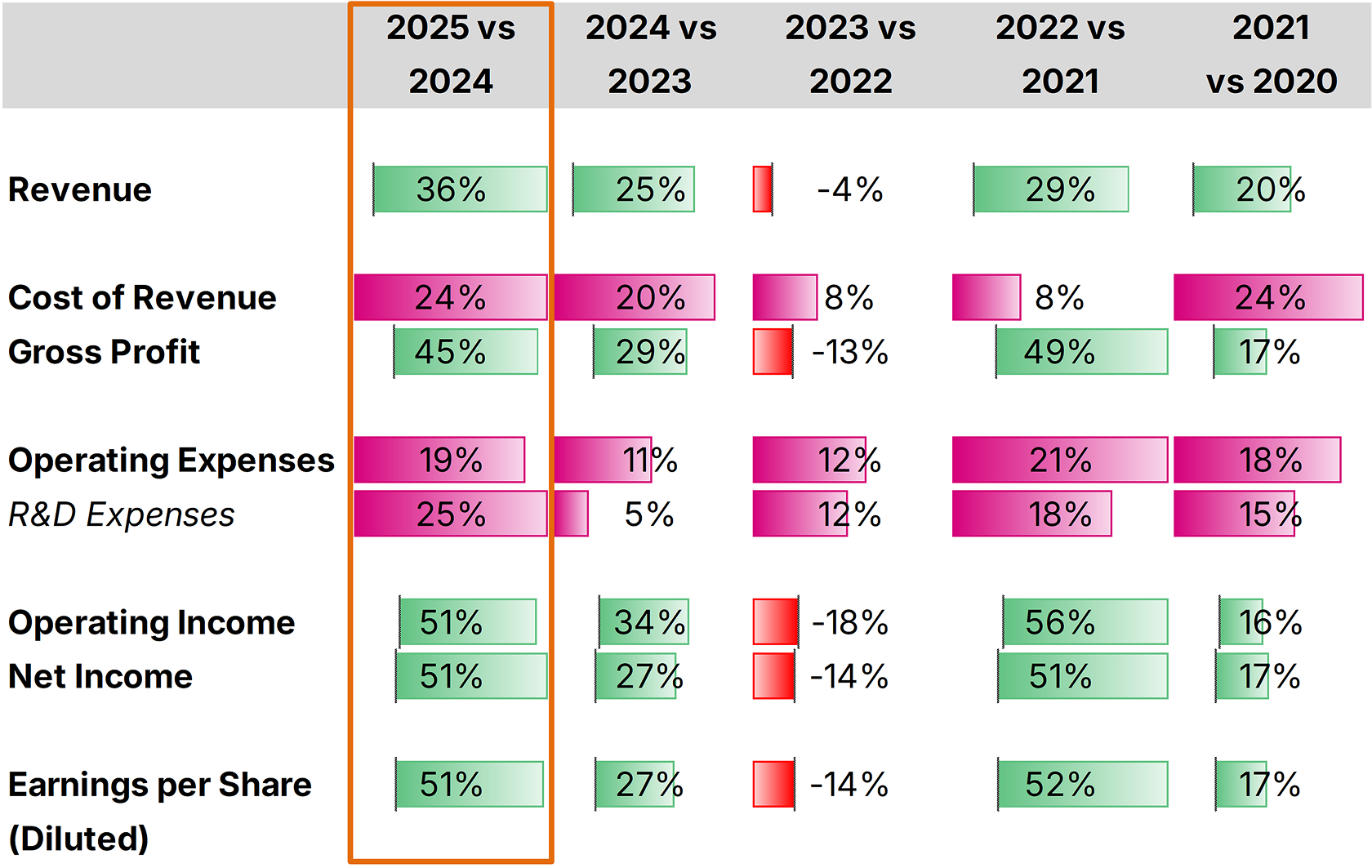
Trend AnalysisFY 2025 witnessed the highest revenue growth for the company over the past five years:
Source: Company Information; Leverage Shares analysis
Meanwhile, the growth in Net Income and diluted Earnings Per Share mirrored the high growth seen in FY 2022 – when the AI boom ramped up and Nvidia started witnessing surges in orders from datacenters.
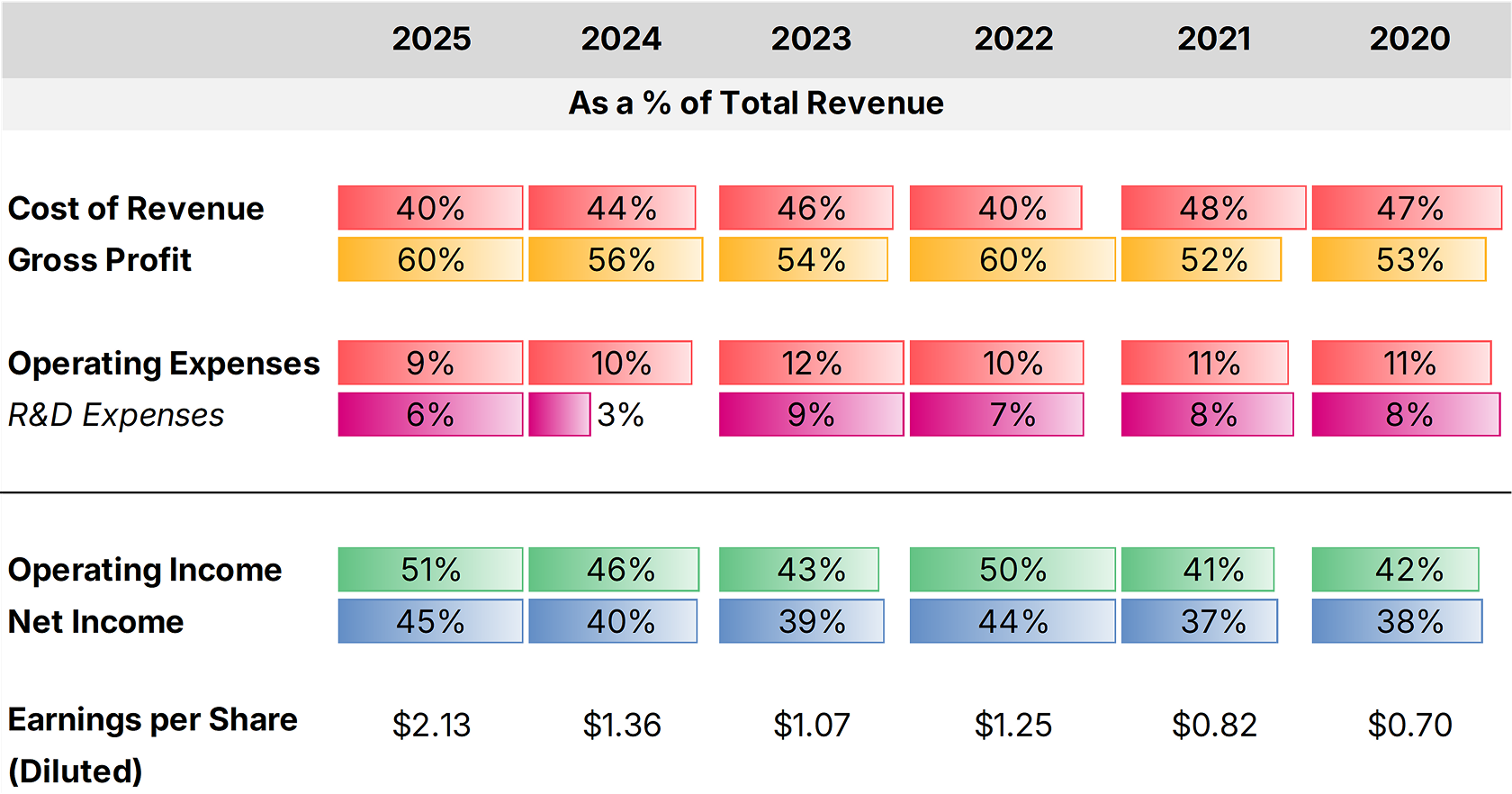
Expenses largely stayed in line with trends seen as of TSMC’s Q3 2025 results1, with R&D expenses in particular spiking by the highest level in 5 years. However, as a percentage of revenue, R&D expenses were at the lowest level after FY 2024:
Source: Company Information; Leverage Shares analysis
Both revenues and net income as well as R&D expenses are close to the high watermarks seen in FY 2022 while diluted earnings per share have nearly doubled.
Despite these trends, market reaction has been largely muted – at least partially by the company’s own measured assessment of its outlook.
Outlook ConcernsWhile TSMC displays solid trends in earnings efficiency, its forward outlook is relatively cautionary. While it registered a net improvement in gross margin by attaining 62.3%, its forward outlook states that its long-term gross margin will show some lowering to “56% and higher” through 2029. The revenue growth rate of 36% in FY2025 over FY2024 will soften and “approach 25%” in U.S. dollar terms in the same period. In the current FY, it anticipates revenue increasing by 30% over FY2025.
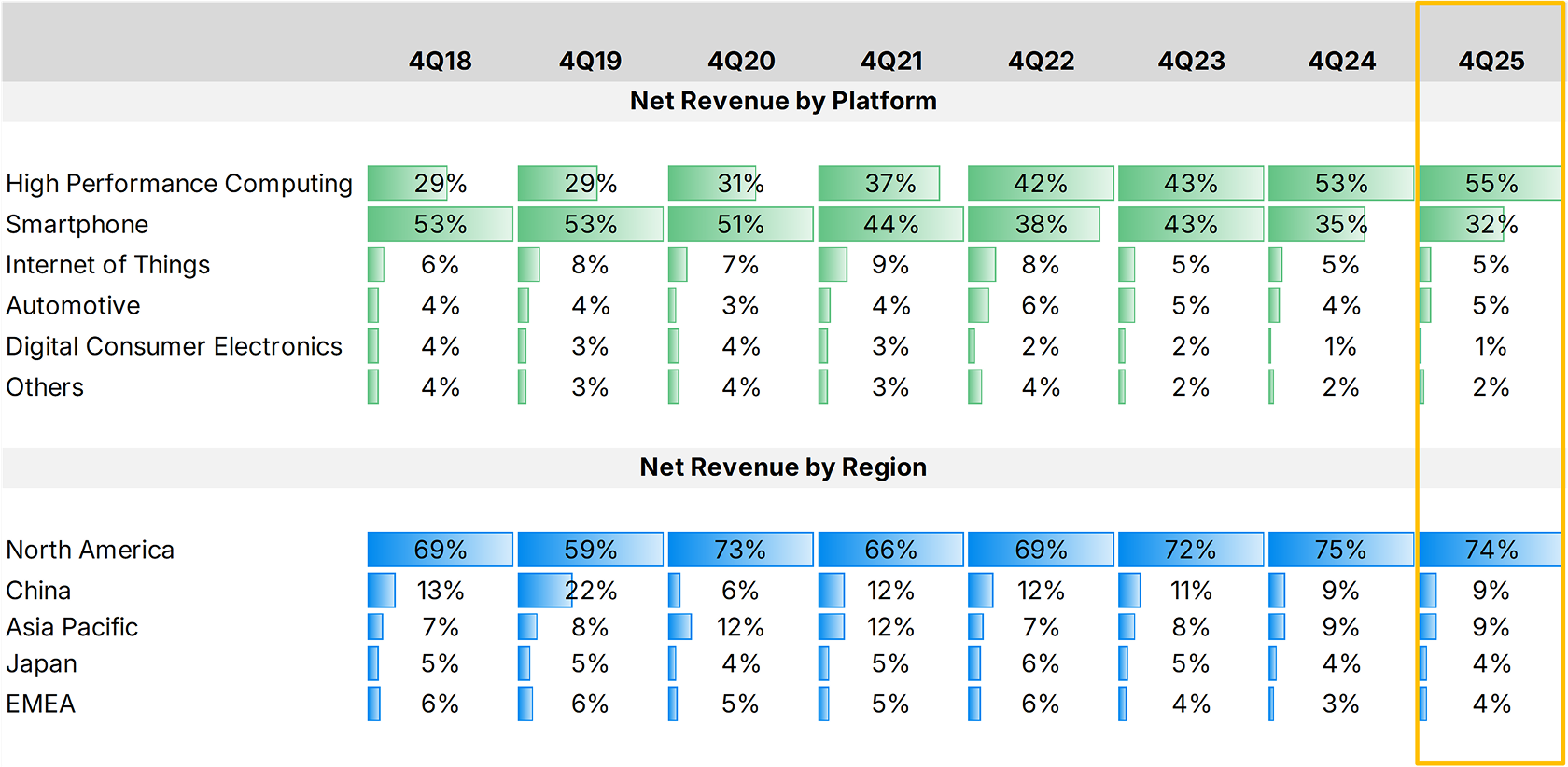
Over the years, TSMC’s geographic and platform revenue contributions have shown increasing signs of concentration:
Source: Company Information; Leverage Shares analysis
In Q4 2025, High Performance Computing – typically meaning products used in datacenters – has remained above the halfway mark in revenue contribution while every other segment has seen a net shrinkage since the end of FY 2018. When considering figures consolidated for FY2025 versus FY 2024, “High Performance Computing” edges even further higher to 58% basis, “High Performance Computing 3nm and 5nm wafers – used in the likes of Nvidia’s Blackwell and Hopper GPUs respectively – are the only wafer technologies that have shown growth in FY 2025 versus FY 2024 with a combined contribution of 60%.
A little under three-fourth of revenue contribution is now being sourced from North America. While China and Asia-Pacific had both shown signs of entering double-digit contribution over the past five years, currently no other region is in the double digits.
What Lies AheadAs the previous article1 had indicated, TSMC’s moat – while formidable financially – would be considered strategically undesirable as geopolitics evolve towards a less globalized order, not least due to the U.S. government’s actions with allies and perceived adversaries alike. If it was a matter of course before similar foundries and fabs running under prominent national names are established in key regions of growth with chip technologies aligned under them, the timeline might have shrunk over the past one year.
In the year till date until the 16th of January, TSMC’s U.S.-listed ticker had risen by 6.9% while the Taiwan-listed ticker rose by 9.8% in the same period. A large part of the valuation increase could be attributed to the notion that TSMC could potentially be a “defensive play” against the relative overvaluation in Nvidia, AMD and other AI-relevant stocks. Since nearly every major chip designer – from Nvidia to Apple – relies on TSMC’s foundries, it could thus be argued that a rise in revenue in these companies translates to the same for TSMC. Furthermore, the mere presence of TSMC’s foundries in Taiwan is arguably the strongest guarantee of a safeguard provided by the likes of the U.S. against potential actions by China, wherein rhetoric over Taiwan’s forcible unification into the People’s Republic of China has exponentially risen in recent times. This notion of a “safeguard” guarantee might have propelled the Taiwanese ticker a degree or two higher than the U.S ticker.
But, all in all, a massive swing higher is altogether unlikely given global geopolitics, the uncertainty over AI adoption benefits that has steadily gained strength over the past quarter or so in the U.S., and the company’s own stated caution on growth in revenue and profits. Resistance to bullish turns can be expected over the course of the next quarter or so (at the very least).
Professional investors in Europe might consider the +3x Long Taiwan Semiconductor ETP (TSM3) and the -3x Taiwan Semiconductor ETP (TSMS) during bullish and bearish trends in the stock. For a broader yet leveraged exposure, the +4X Long Semiconductor ETP (SOXL) and the -4X Short Semiconductor ETP (SOXS) are at hand.
Footnotes:
- "TSMC’s Q3 2025 Results Couldn’t Lower China Concerns", Leverage Shares, 24 October 2025
Your capital is at risk if you invest. You could lose all your investment. Please see the full risk warning here.
 Market Insights
 Education

